Systems Management
Disciplines
Prepared by: Thomas Bronack, president
Data Center Assistance Group, Inc.
78-17 164th Street
Flushing, New York 11366
Phone: (718) 591-5553 Fax: (718) 380-7322
Email: bronackt@dcag.com
Table of Contents
The typical Data
Processing environment
Systems Management
and Controls overview
Standards and
Procedures Manual - Structure
SMC Disciplines
and Organizational Structure
Service Level
Agreements (SLA) and Service Level Reporting (SLR)
Inventory
Management and Configuration Management
Application
Development and Project Life Cycle (PLC)
Quality Assurance
Organizational Structure
Application
Management – Process Flow Diagram
The best insurance
against disasters
How Disaster occur
and procedures for avoiding them…
Disaster Recovery
Function integration
DCAG Disaster
Recovery Services
Contingency
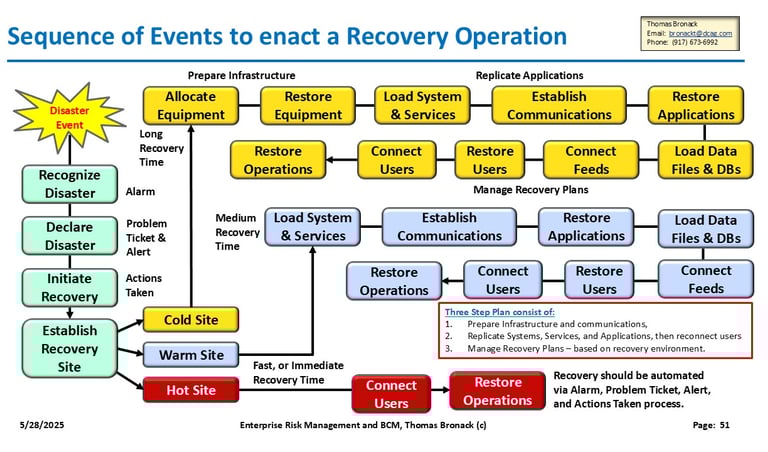
Recovery Operations
DCAG Contingency
Planning Services
Table of Figures
Figure 1: Quality Assurance and Project Life Cycle
Checkpoints
Figure 2: Systems Management and Controls overview
Figure 3: Standards and Procedures Manual - Structure
Figure 5: SMC Disciplines and Organizational Structure
Figure 6: Service Level Management and Service Level
Reporting
Figure 7: Configuration and Infrastructure Management
Figure 8: Capacity Management - Process Flow
Figure 9: Performance Management - Process Flow
Figure 10: Application Development and Project Life
Cycle (PLC)
Figure 11: Application Maintenance - Project Life Cycle phases
Figure 12: Application Testing Procedures
Figure 13: Quality Assurance Principles
Figure 14: Quality Assurance Structure
Figure 15: Application Management - Process Flow
Diagram
Figure 16: Production Application Management
Figure 17: Application Life Cycles and Production
Operations
Figure 18: Why you need a Disaster Recovery Plan
Figure 19: The best insurance against disasters....
Figure 20: How disasters occur, and avoiding them...
Figure 21: Disaster Recovery Services that must be
performed
Figure 22: Overview of DCAG Disaster Recovery Functions
Figure 23: DCAG and Disaster Recovery Services
Figure 24: DCAG Disaster Recovery Services
Figure 25: Crisis Command Center structure
Figure 26: Contingency Recovery Operations
Figure 27: DCAG Contingency Planning Services
Figure 28: EDP Security Management Services
Figure 29: Vital Records Management
Figure 30: Change Control Process
Figure 31: Problem Recovery Techniques
When data processing was first introduced to business in the late 1950’s and early 1960’s it was not initially accepted, because of fear and lack of knowledge on how to utilize the computers and peripheral devices attached to computers. Then, after a short while, people lost their fear and began using data processing in ways that nobody had previously expected - resulting in rampant growth and an uncontrolled environment.
In order to gain control over data processing, management needed to develop disciplines that would provide personnel with standards and procedures, which would enhance efficiency and improve productivity. Eventually, these new disciplines were codified into the Systems Management and Controls (SMC) utilized by most data processing organizations today.
This document will provide the reader with a general overview of data processing and the SMC disciplines used to control and manage Information Technology environments.
Figure 1: Quality Assurance and Project Life Cycle Checkpoints
Figure 1 depicts a normal application development and implementation cycle, from the request for a new business application (“Create Service Request”) through the Testing and Quality Assurance process, to submitting the application to Production Acceptance. The picture is used to should how complicated the process is and why there is a need for Systems Management and Control disciplines.
Checkpoints are used to reduce errors and insure that all personnel associated with application development and support are aware of new and changing application functions.
Figure 2: Systems Management and Controls overview

Figure 2 depicts the stages associated with implementing, supporting, and maintaining applications within the data processing environment. Systems Management and Control functions and disciplines are shown in the process where they occur. For example, Service Level Management procedures must be accomplished (both Service Level Agreements (SLA) and Service Level Reporting (SLR)) contracts must be in place before either Application Development or Maintenance work can be performed.
As shown in Figure 1, and again here in Figure 2, the sequence of events associated with propagating an application from inception to Production Operations consists of: Development, Testing, Quality Assurance, Production Acceptance, and then finally Production Operations. If the application is critical in nature, then Vital Records Management, Disaster Recovery, and Off-Site Vaulting must be accomplished. Both mainframe and office recovery procedures must be developed, tested, and implemented along with production acceptance for critical applications. This insures that critical applications and their associated data files are safeguarded and capable of recovery, should a disaster event occur.
Disaster Plans must be developed for both mainframe resources and End User business offices, when critical applications are moved into the Production environment. This insures that the business associated with the application can continue, should either the data center or the business office is lost due to a disaster event. Additionally, Vital Records Management, EDP Security (both Physical and Data Security), and Off-Site Vaulting must be accomplished for a critical application to be accepted into the Production environment. This implies that Disaster Recovery and Off-Site Vaulting contracts be expanded to include any new capacity or data files.
When a Change is made to an application, the current Production module(s) is moved to the Maintenance environment (Component and Release levels are upped by one to indicate that a Change is in process) and the Maintenance Project Life Cycle is initiated. Afterwards, applications Test, Quality Assurance, Production Acceptance, and Production Operations procedures are followed.
This closed-loop process ensures that applications adhere to the Standards and Procedures associated with an organization and that the highest level of Quality Assurance is maintained over the data processing environment.
As data processing procedures evolved a set of disciplines were developed to control this process. These disciplines were named Systems Management and Controls.
In order to insure that Systems Management and Controls were understood and followed by data processing personnel, most companies developed Standards and Procedures Manuals to define how work is requested, processed, and validated. Through the use of these Standards and Procedures, improvements in efficiency and productivity were achieved, thereby optimizing the data processing environment while safeguarding vital data processing resources.
Figure 3: Standards and Procedures Manual - Structure


Systems Management and Controls (SMC) disciplines have been developed to aid Information Technology Management manage the data processing environment and improve productivity. SMC functional responsibilities can be applied to both the mainframe and distributed data processing environments. When implemented, SMC disciplines will improve productivity and the quality of work being processed through a data processing organization. SMC disciplines are identified in Figure 1.
Figure 5: SMC Disciplines and Organizational Structure

SMC disciplines should be implemented from left to right, with each column being completed before proceeding to the next. Each of these disciplines is described in the following pages.
Service Level Agreements (SLA’s) should be developed between the Information Technology organization and End Users first. These documents are used to define the amount of processing power needed by the End Users, the hours of operation associated with end user work, and what to do with end user output (output balancing and distribution). Once SLA’s have been developed, it will be possible to define the amount of data processing Capacity and the Performance objectives associated with End User work load demands.
Once SLA’s have been defined, Service Level Reporting (SLR) can be devised and implemented to insure that End Users are being provided with the level of processing they expected.
Figure 6: Service Level Management and Service Level Reporting

The SMC disciplines of Capacity Management, Performance Management, Facilities Management, and Data Center Operations are used to provide Service Level Reporting. The SLR is compared with the SLA to insure that End User computing adheres to the level agreed to by the End User and the Data Processing Organization.
Inventory Management is used to define all of the components associated with an End User’s office and applications, including fixed assets, office equipment, personnel, and data processing components. An Inventory Management data base is usually created to identify assets, their financial profile, and configuration. This makes it easier to track and manage assets within the organization.
Configuration Management is used to manage where resources are kept and how they are connected to the data processing environment. Many areas within the organization are concerned with Configuration Management, as is depicted in Figure 5. Both physical components and personnel are included within a configuration. This makes it easier to define recovery requirements and costs associates with the support of an End User’s configuration.
Figure 7: Configuration and Infrastructure Management

Figure 8: Capacity Management - Process Flow

Capacity Management
Figure 9: Performance Management - Process Flow

Performance Management
Figure 10: Application Development and Project Life Cycle (PLC)

Application Development and Project Life Cycle (PLC)
Figure 11: Application Maintenance - Project Life Cycle phases

Application Maintenance
Figure 12: Application Testing Procedures

Application Testing
Figure 13: Quality Assurance Principles

Quality Assurance
Figure 14: Quality Assurance Structure

Figure 15: Application Management - Process Flow Diagram

Figure 16: Production Application Management

Production Acceptance

Figure 17: Application Life Cycles and Production
Operations
Production Operations
Figure 18: Why you need a Disaster Recovery Plan

Figure 19: The best insurance against disasters....

Figure 20: How disasters occur, and avoiding them...

Since Disaster are no more than problems affecting critical resources or services, it stands to reason that every effort should be made to avoid problems or at the very least react to them as rapidly as possible. Problem Management and Recovery Management are therefore married and should be treated in unison when critical resources are developed, maintained, or supported.
Figure 21: Disaster Recovery Services that must be performed

Figure 22: Overview of DCAG Disaster Recovery Functions

Recovery Management services provided by DCAG include a Business Impact Analysis, Risk Assessment, Contingency Plan Review or Evaluation, and Integration of Recovery Plans with the Help Desk and Problem Management function.
Figure 23: DCAG and Disaster Recovery Services

Figure 24: DCAG Disaster Recovery Services

Figure 25: Crisis Command Center structure

Figure 26: Contingency Recovery Operations

Figure 27: DCAG Contingency Planning Services

Figure 28: EDP Security Management Services

EDP Security Management
Figure 29: Vital Records Management

Vital Records Management
Figure 30: Change Control Process

Change Management
Figure 31: Problem Recovery Techniques

Problem Management